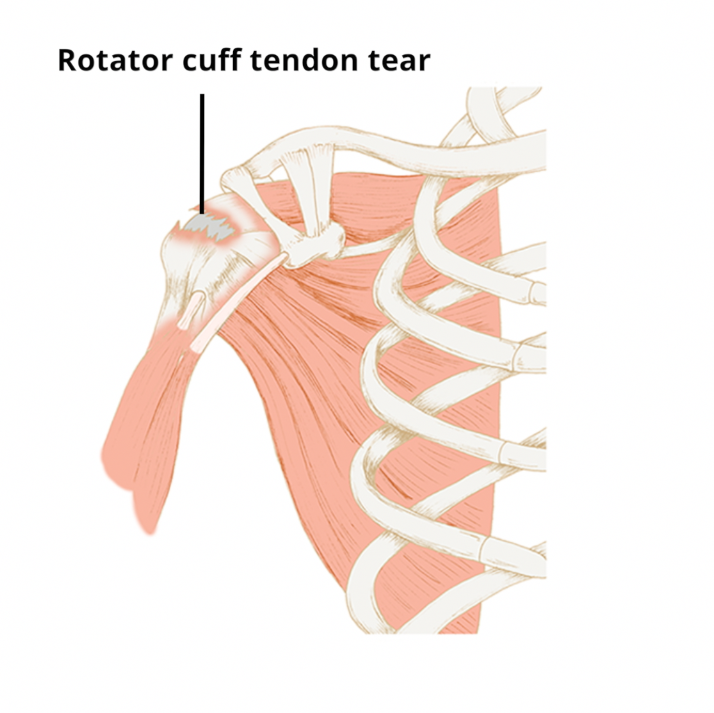
A rotator cuff tear occurs when the muscles around the shoulder (rotator cuff) develop a small hole, usually in the tendon of the muscle. This may be the result of trauma or as a natural part of the ageing process. Although the tear itself won't heal, in the majority of cases, the pain settles over time and the other parts of the rotator cuff are able to strengthen and compensate.
The rotator cuff refers to a group of tendons and muscles in the shoulder which attach the scapula (shoulder blade) to the humeral head (upper arm bone). The rotator cuff muscles provide significant tension across the joint;
- Stabilising the humeral head (ball of the shoulder joint) in the centre of the glenoid (socket of the shoulder joint), allowing for a large range of joint movement.
- Allowing more powerful muscles around the shoulder to provide the tension needed to move the shoulder.
Most people tell us that they experience shoulder pain and weakness. The pain is often felt in the upper arm to the elbow. Some people may also experience a loss of muscle strength, which can vary in severity. For some, this weakness may result in an inability to lift the arm at all, whilst for others it might only be noticeable when they are trying to lift things.
Pain on movements of the arm above the head, behind the back and across your body are usually the most painful movements. Lifting any significant weight with these movements will normally increase symptoms further.
A rotator cuff tear can be diagnosed by your clinician by talking to you about your symptoms and by conducting a physical examination.
The main features on examination are often pain and weakness when resisting rotational movements and movements of the arm away from the side.
An ultrasound scan may be required to assess the extent of any rotator cuff tear. This may guide future management including a possible surgical repair.
X-Rays are often used to make sure there is no bone/joint involvement, but this is more commonly reserved for people who are considering surgery.