Acute pain usually happens after a specific injury—such as an ankle sprain. It acts as the body’s alarm system, telling us to rest so tissues can heal.
- Most acute pain improves within 6–12 weeks, though some injuries may take up to 6 months to fully settle.
- The amount of pain you feel can vary depending on the severity of the injury, previous experiences, and how worried or stressed you feel.
This type of pain is useful because it protects the injured area.
Persistent (chronic) pain lasts beyond the expected healing time.
Research shows it’s not usually due to ongoing damage. Instead, the nervous system becomes sensitised—a bit like the volume on a radio stuck on loud. This means you may feel pain even when the tissues are healthy.
- Persistent pain no longer serves a protective purpose and can make day‑to‑day activities difficult.
- The good news is that the “volume” can be turned down, but it takes time, practice, and the right strategies.
- Quick fixes like medications, injections, or surgery are often less helpful for this type of pain.
Persistent pain can affect many areas of life:
Reduced activity
Pain often leads to moving less. Over time this can cause:
- Muscle weakness
- Reduced fitness
- Poorer sleep
- A “vicious cycle” where symptoms gradually worsen
Emotional wellbeing & relationships
Persistent pain can also:
- Affect your patience
- Increase negative thoughts
- Lower your mood
- Reduce your ability to join in with activities you previously enjoyed
Although these challenges are common, there are positive steps that can help break the cycle. Support from the Circle MSK service can help you regain confidence and manage symptoms effectively.
Many people describe feeling caught in a “pain trap” — patterns that unintentionally worsen symptoms. These may include:
Behavioural traps
- Pushing yourself too hard on good days
- Avoiding activity completely on bad days
- Relying heavily on short‑term fixes
External or emotional factors
- Stress
- Poor sleep
- Worry or fear about movement
Understanding these patterns is an important step in gaining control of your pain and improving quality of life.
Pain can change how we move, sleep, think and feel. Many people fall into two common cycles:
- Boom–bust: pushing hard on good days → flare‑ups → long rest → repeat.
- Under‑activity: avoiding movement due to fear → deconditioning → worse sleep/mood → more pain.
These patterns are understandable and common, but the benefits are only short‑term and can keep pain going. Simple strategies (pacing, graded activity, sleep routines, stress skills) help break the cycle.
Next step: Ask about pain management programme to learn pacing, flare planning, and thought‑skills
Negative automatic thoughts are something that we can all relate to! These are the thoughts that automatically pop into our heads, quite uninvited; some people may notice these more often.
Examples of negative automatic thoughts are:
"Why does this always happen to me?"
"I know exactly what he/she is thinking……"
"I will never get out of this mess"
Everyone has these thoughts but some people may pay more attention to them than others. Taking time to notice that these automatic thoughts can impact on how you feel can be important, as these thoughts are rarely helpful. If you find yourself dwelling on these thoughts, it would be sensible to speak with your GP or health professional.
Persistent pain is usually diagnosed by a clinician after listening to your story, examining you, and ruling out other causes. There isn’t a single blood test or scan that “proves” persistent pain. Often the pain is linked to nervous system sensitisation (the body’s alarm stuck on loud).
Tests (like bloods or imaging) may be used to exclude other problems but aren’t always useful once serious conditions are ruled out.
The videos below explain how persistent pain can develop:
Sometimes symptoms persist even when tests don’t find a clear cause. Estimates vary, but medically unexplained symptoms account for about 1 in 4 GP consultations, and some studies report up to 45% in general practice; in hospital clinics, around half of new patients may have no clear diagnosis at 3 months.
You’re not alone, and support focuses on education, self‑management, and addressing factors that keep symptoms going.
Fibromyalgia causes widespread pain, fatigue, poor sleep, and “fibro‑fog”. It affects around 2–5% of people, often triggered or worsened by physical or emotional stressors. There’s no single test; diagnosis is clinical.
Diagnosis is usually carried out in primary care by a GP, and it is a clinical diagnosis based on history and examination.
Management is multimodal: graded activity and exercise, sleep strategies, psychological therapies, and selected medicines.
You can find useful information using these links:
We tailor care around your needs. Options may include:
- Multidisciplinary pain team & pain management programme (education, pacing, flare planning, movement, sleep, thought‑skills).
- Clinical Psychology (reduce catastrophising, improve coping).
- Back Skills Training for low back pain (exercise + psychologically informed care).
- Physiotherapy / Osteopathy/Rehabilitation (graded activity, strength/flexibility, confidence).
For acute injuries, short‑term medicines and gentle movement can help while tissues heal; for persistent pain, we focus on supported self‑management and evidence‑based strategies rather than “quick fixes.”
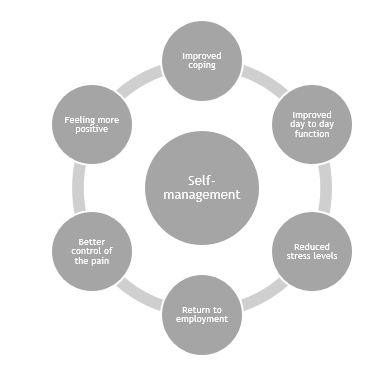
Self-Help, or Self-Management is essential in the management of persistent pain, as it helps people reduce their reliance on healthcare professionals and take control of the management of your symptoms.
We aim to work with you to reduce your pain and improve quality of life. This is involves supporting you to take an active role in your own well-being. Research has shown that self-management of persistent pain is beneficial in the long term.
Self-Management however, is an important step and offers a positive way to improve quality of life. This explores how you may be able to live a normal life, despite a change in health. This usually includes pacing activities, exercise, sleep management, positive thinking, goal setting and relaxation techniques.
Benefits vary for each person and can also vary according to how well you engage and are willing to try each technique, sometimes people can become over-reliant on healthcare professionals to manage their symptoms. This helps develop a strategy that works for specifically for you.
Our Pain Management Programme uses a multidisciplinary approach to help you understand and manage persistent pain. It combines:
- Pain education – how pain works and why it persists
- Psychology – strategies to manage thoughts, stress and flare‑ups
- Physical approaches – pacing, movement, exercise and relaxation
You can take part virtually or in person.
In‑person programme format
- 2‑hour group session
- Once a week
- Over 6 consecutive weeks
- Practical tools to help you build confidence and manage symptoms day‑to‑day
Free taster resources
If you’d like to get a feel for the content, you can access free educational modules at retrainpain.org
Find out more:
Consultation and treatment options vary between our services, and not all of the options below are available in each service.
APP Assessment (Advanced Practitioner Physiotherapist/Clinician)
A specialist clinician will:
- Listen to your symptoms and concerns
- Assess your movement
- Explore what factors may be contributing to your pain
- Discuss treatment options tailored to your goals
Pain Nurse Review
Our pain nurses can:
- Review your current medications
- Check whether they are helping
- Identify medicines that may no longer be useful
- Support safe reduction where appropriate
- Offer guidance on side‑effects and alternative approaches
The aim is to find the safest, simplest and most effective medication plan for you.
Pain Psychology
Our psychologists explore:
- What your pain feels like and how it affects your life
- Any stresses, fears or worries linked to your symptoms
- How thoughts, emotions and behaviours influence pain
- Skills to improve resilience, reduce distress and regain control
These sessions can help you develop healthier coping strategies and improve quality of life.
Rehabilitation
Rehabilitation focuses on:
- Gentle, graded exercise
- Building strength and activity levels
- Improving confidence with movement
- Relaxation and recovery techniques
The aim is to make everyday activities easier, reduce flare‑ups and support long‑term progress.
Pain Consultant Review
Pain consultants are anaesthetists with specialist training in pain interventions.
They may offer treatments such as:
- Image‑guided injections
- Diagnostic or therapeutic procedures
However:
- These interventions often provide short‑term relief only
- They are not usually helpful for widespread pain conditions
- They are typically considered after active treatments such as physiotherapy, pain programmes and appropriate medication trials
Your consultant will discuss whether an intervention is likely to benefit you.
There are a range of websites where further information can be sought, see below
Action on Pain Helpline: 0845 603 1593 | www.action-on-pain.co.uk
Away with Pain: www.awaywithpain.co.uk
The British Pain Society: 020 7269 7840 | www.britishpainsociety.org
Fibromyalgia Association UK Helpline: 0844 887 2444 | www.fmauk.org
FibroAction: 0844 443 5422 | www.fibroaction.org
International Association for the Study of Pain (IASP): www.iasp-pain.org
Pain toolkit: www.paintoolkit.org
Pain Concern Helpline: 0300 123 0789 | www.painconcern.org.uk
Pain UK: www.painuk.org | Twitter @pain_uk
Versus Arthritis: www.versusarthritis.org